
The idea of a unified global narrative has always relied on underlying alignment. When governments, markets and institutions share motivations, common frameworks and coordinated messages follow. The power of global issues alignment stemmed not from the fact that global is good, but from the underlying commonalities that support unity.
It is now clear that the alignments have weakened. Diverging political priorities, economic incentives and regulatory approaches have eroded coherence. What remains is not a single, unified narrative but a fragmented environment, where signals travel unevenly and meaning shifts by market.
Davos did not cause this shift. It made it visible. Long positioned as a forum for shared forecasts and collective commitments, this year’s meeting revealed how far motivations have moved apart. Power, markets and institutions are adapting in parallel rather than in concert.
The progression of conversations reflected this reality. Early discussions at Davos focused on geopolitics and economic posture (i.e., alliances, trade, tariffs and security exposure) before pivoting to AI. Even there, unity proved limited.
Initial debates focused on competitiveness and productivity, then narrowed to governance, regulation, security and privacy. The movement was not toward consensus, but toward clearer lines of difference.
Three signals stood out.
- Narrative volatility is structural, not episodic. Themes shifted rapidly, often before earlier debates were resolved. This volatility reflects competing priorities operating simultaneously, without a shared hierarchy of objectives.
- Narratives harden faster than facts. Traditional media outlets continue to set the frame with rapid amplification across digital platforms. Early interpretations often crystallize into the dominant takeaway. Once established, those frames are difficult to unwind.
- Global signals no longer produce global outcomes. U.S. political and market signals still matter, but they do not translate uniformly. Stakeholders interpret the same events through local lenses like regulatory regimes, political pressures and domestic priorities, often arriving at different conclusions. Where motivations diverge, unified response is no longer possible.
The Takeaway for Communicators
The lesson from Davos is not how to communicate globally. It is how to communicate when alignment can no longer be assumed.
In periods of alignment, unified messages travel far because objectives reinforce one another. In periods of divergence, the same messages fracture as they move. The communicator’s task has shifted from managing a single narrative to preserving credibility and clarity across multiple environments and audiences.
This environment rewards discipline over volume, preparation over improvisation, proof over intent and selective engagement.
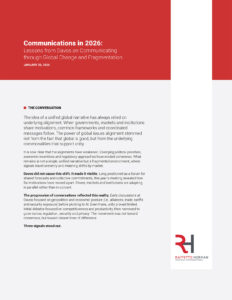
Download the full PDF report for the full takeaways: Communications in 2026: Lessons from Davos on Communicating through Global Change and Fragmentation.
***
RH Strategic is a Seattle and D.C.-based PR agency with a nationwide presence and additional global reach via membership in the Worldcom Public Relations Group. We provide strategic public relations for innovators in the technology, government, healthcare, and social and environmental impact markets.